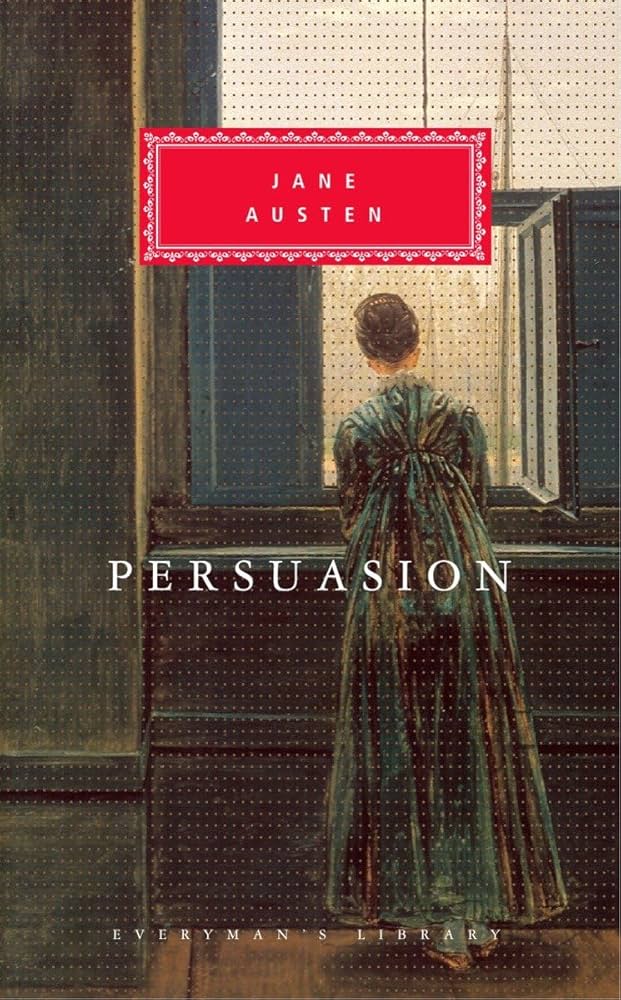
If Pride and Prejudice feels like Spring, Persuasion definitely feels like Autumn, which is puzzling seeing that both books start in Autumn (both Mr Bingley and Admiral Croft are said to settle in Netherfield Hall and Kellynch Hall respectively at Michaelmas, that is the end of September). Anne loves the autumn scenery too – Anne’s object was, not to be in the way of anybody; and where the narrow paths across the fields made many separations necessary, to keep with her brother and sister. Her pleasure in the walk must arise from the exercise and the day, from the view of the last smiles of the year upon the tawny leaves, and withered hedges, and from repeating to herself some few of the thousand poetical descriptions extant of autumn, that season of peculiar and inexhaustible influence on the mind of taste and tenderness, that season which had drawn from every poet, worthy of being read, some attempt at description, or some lines of feeling. She occupied her mind as much as possible in such like musings and quotations.
Persuasion is my second favourite Jane Austen book and I just couldn’t resist picking it up again this January. Reading both books back to back highlighted their differences but also their similarities. Here are the quotes that stood out to me the most, as well as a few of my notes, in reading order.
‘He had distinguished himself, and early gained the other step in rank, and must now, by successive captures, have made a handsome fortune. She had only navy lists and newspapers for her authority, but she could not doubt his being rich.’ – Anne of Captain Wentworth. This book is absolutely about longing. In Pride and Prejudice, we barely see Lizzie yearn for Darcy and he falls for her first so it’s a matter of waiting for them to resolve their differences. In Persuasion, Anne is always longing for Wentworth, pining for him and the reader has no notion of his feelings in return. It’s heartbreaking to think of Anne quietly going through the newspapers for any mention of Wentworth and keeping track of his progress from afar.
‘She had been forced into prudence in her youth, she learned romance as she grew older‘
‘The Baronet will never set the Thames on fire, but there seems to be no harm in him.’ Admiral Croft of Sir Walter. This is a hilarious quote.
Note on the difference between Anne and Louisa/Henrietta – ‘Henrietta and Louisa were living to be fashionable, happy, and merry. Anne always contemplated them as some of the happiest creatures of her acquaintance; but still, she would not have given up her own more elegant and cultivated mind for all their enjoyments.‘ I’ve said it before with Lizzie but this is another example of one of Jane Austen’s heroines thinking herself superior to lighthearted girls of her acquaintance. I don’t know how I feel about that if I’m being honest. She also wonders later on whether Wentworth thinks Louisa’s stubborness is such an advantage after she dismisses everybody’s warnings and falls. There are several instances when seeing the heroine for the gem she is is presented as the one thing that’s important – people who overlook Anne are always villains. ‘Lady Russell had only to listen composedly, and wish them happy, but internally her heart revelled in angry pleasure, in pleased contempt, that the man who at twenty-three had seemed to understand somewhat of the value of an Anne Elliot, should, eight years afterwards, be charmed by a Louisa Musgrove.’
‘She must now submit to feel that another lesson, in the art of knowing our own nothingness beyond our own circle‘ Anne of the Musgroves, of whom she’s very fond but you do feel her loneliness in this book. She was desperate to talk about how distressed she was at having to move to Bath but the Musgroves dismissed the whole move in a few quick remarks, leaving Anne forlorn. They’re not unkind at all but this is a case where the heroine never really enjoys the comforts of home anywhere she goes. Another quote about loneliness is to be found when Anne sits at the piano at the Musgroves and they expect her to entertain them but never think of her as being quite accomplished, never appreciate her and take her for granted. ‘She knew that when she played she was giving pleasure only to herself.’
‘I do believe if Charles were to see me dying, he would not think there was anything the matter with me‘ I do love the comedic relief that is Mary.
Note on Anne and Wentworth – again, about the longing. This is a very physical book. Anne years for Wentworth’s presence so much she’s always aware of where exactly he is in any one room. There’s a scene where she’s keenly aware that only Mrs Musgrove separates them on the sofa. I think the tension in this book is incredible. This happens numerous times besides – when Wentworth frees her from little Charles’s overwhelming attentions when he’s injured, when Wentworth places her in the carriage after their group walk (‘he could not see her suffer, without the desire of giving her relief‘). Physical contact and proximity to that contact is everywhere in this book.
Note on the Crofts – I adore them. They’re the best couple of the book and Anne also admires them very much. Admiral Croft’s lack of pretense and no-nonsense attitude with not a hint of self-possession and Mrs Croft’s love of the sea and of adventures when following her husband on his campaigns. They’re up there with the Gardiners of Pride and Prejudice. They’re quite a model for Anne. ‘As long as we could be together, nothing ever ailed me. Women may be as comfortable on board, as in the best house in England. I hate to hear you talking so like a fine gentleman, and as if women were all fine ladies, instead of rational creatures. We none of us expect to be in smooth water all our days.’ Let’s hope Frederick is busy taking notes.
A scenic tour – in Pride and Prejudice, we’re treated to a tour of Pemberley and its grounds. Here, Lyme is granted special attention. It’s a beautiful description. After securing accommodations, and ordering a dinner at one of the inns, the next thing to be done was unquestionably to walk directly down to the sea. They were come too late in the year for any amusement or variety which Lyme, as a public place, might offer. The rooms were shut up, the lodgers almost all gone, scarcely any family but of the residents left; and, as there is nothing to admire in the buildings themselves, the remarkable situation of the town, the principal street almost hurrying into the water, the walk to the Cobb, skirting round the pleasant little bay, which, in the season, is animated with bathing machines and company; the Cobb itself, its old wonders and new improvements, with the very beautiful line of cliffs stretching out to the east of the town, are what the stranger’s eye will seek; and a very strange stranger it must be, who does not see charms in the immediate environs of Lyme, to make him wish to know it better. The scenes in its neighbourhood, Charmouth, with its high grounds and extensive sweeps of country, and still more, its sweet, retired bay, backed by dark cliffs, where fragments of low rock among the sands, make it the happiest spot for watching the flow of the tide, for sitting in unwearied contemplation; the woody varieties of the cheerful village of Up Lyme; and, above all, Pinny, with its green chasms between romantic rocks, where the scattered forest trees and orchards of luxuriant growth, declare that many a generation must have passed away since the first partial falling of the cliff prepared the ground for such a state, where a scene so wonderful and so lovely is exhibited, as may more than equal any of the resembling scenes of the far-famed Isle of Wight: these places must be visited, and visited again, to make the worth of Lyme understood.
Note on Mr Elliot – every Jane Austen book has got a mystery, almost always a secondary character who’s a little bit of a puzzle is attached to somebody the reader and the heroine would never suspect when the character’s true colours are revealed. Wickham attaches himself to Lydia, Sir Elliot to Mrs Clay.
‘My idea of good company, Mr Elliot, is the company of clever, well-informed people, who have a great deal of conversation; that is what I call good company.’ Hear, hear.
Note on Anne and Wentworth – For all of Anne’s measured and composed behaviour (she has the coolest head, can be relied on always), what attracts her in Wentworth is how open and warm he is. How he always says exactly what he thinks with no calculations. I couldn’t agree with her more. ‘Mr Elliot was rational, discreet, polished, but he was not open. There was never any burst of feeling, any warmth of indignation or delight, at the evil or good of others. This, to Anne, was a decided imperfection. Her early impressions were incurable. She prized the frank, the open-hearted, the eager character beyond all others. Warmth and enthusiasm did captivate her still. She felt that she could so much more depend upon the sincerity of those who sometimes looked or said a careless or a hasty thing, than of those whose presence of mind never varied, whose tongue never slipped.‘
‘It was agitation, pain, pleasure, a something between delight and misery.‘
I loved this hilarious passage that shows that Jane Austen’s isn’t much moved by sensibility – ‘Prettier musings of high-wrought love and eternal constancy, could never have passed along the streets of Bath, than Anne was sporting with from Camden Place to Westgate Buildings. It was almost enough to spread purification and perfume all the way.‘
The Letter – My god, the letter. It’s so good. Nothing to add here.
“I can listen no longer in silence. I must speak to you by such means as are within my reach. You pierce my soul. I am half agony, half hope. Tell me not that I am too late, that such precious feelings are gone for ever. I offer myself to you again with a heart even more your own than when you almost broke it, eight years and a half ago. Dare not say that man forgets sooner than woman, that his love has an earlier death. I have loved none but you. Unjust I may have been, weak and resentful I have been, but never inconstant. You alone have brought me to Bath. For you alone, I think and plan. Have you not seen this? Can you fail to have understood my wishes? I had not waited even these ten days, could I have read your feelings, as I think you must have penetrated mine. I can hardly write. I am every instant hearing something which overpowers me. You sink your voice, but I can distinguish the tones of that voice when they would be lost on others. Too good, too excellent creature! You do us justice, indeed. You do believe that there is true attachment and constancy among men. Believe it to be most fervent, most undeviating, in
F. W.
“I must go, uncertain of my fate; but I shall return hither, or follow your party, as soon as possible. A word, a look, will be enough to decide whether I enter your father’s house this evening or never.”
 Magical Emma Rose